
Selected exhibitions& projects.
Every object has a memory. Every material carries a lineage. House of Oye works at the intersection of heritage, design, and storytelling — building environments where the objects chosen, the textiles placed, and the spatial logic applied are never incidental. In the tradition of the griot, the studio holds the thread between a collaborator's vision and the deeper African and diasporic inheritance it belongs to — and pulls until the room itself begins to speak.
Fiona — The Altar
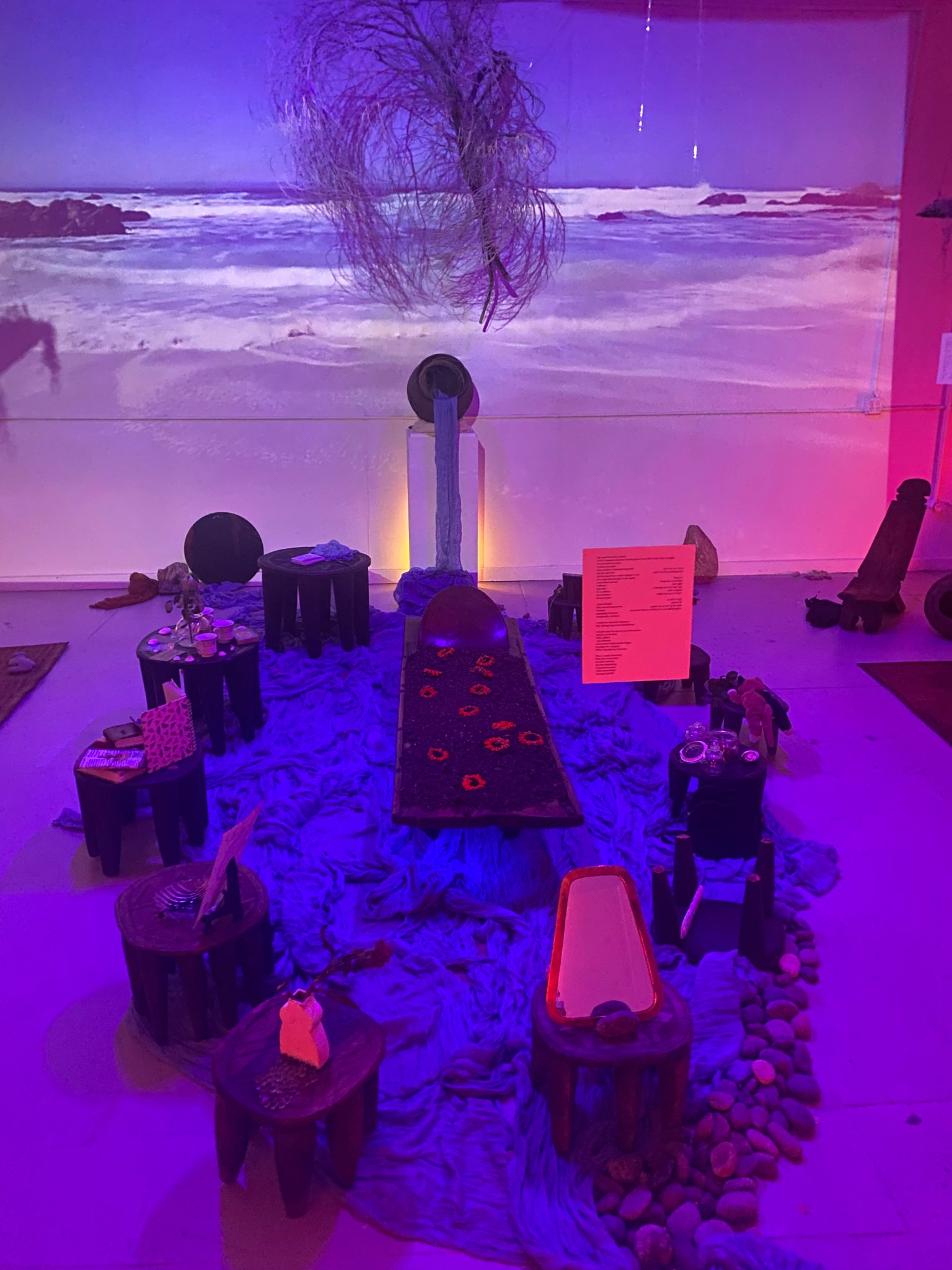
ScopePerformer and collage artist Fiona approached House of Oye to design an immersive environment for The Altar — a live performance moving through twelve energies as a pathway toward breaking a generational cycle of sexual abuse, culminating in the twelfth and final energy: Tell My Story.
Rooted in four years of studying energetics, spirituality, and symbolic interactionism, Fiona's practice asks a single question: what does it look like to be a cycle breaker? House of Oye built the world that question would live inside.
Twelve altars were designed with deliberate curatorial intention. Eleven handcrafted wooden stools of the Nupe people of northern Nigeria — objects historically reserved for prestige and important gatherings — anchored the first eleven. For the twelfth, a Senufo bed from Ivory Coast, holding the full spectrum of human experience: birth, rest, ceremony, and the guided passage of the dead. Each object was chosen as an active collaborator in the storytelling, its own ancestral history in direct conversation with the performer's.
Beyond the spatial design, House of Oye mentored Fiona through the performance process itself — helping her understand how space, object, and energy speak to one another, and how her own ancestral inheritance could be honored inside the environment being built around her. The result was a space where personal healing and collective memory occupied the same room at the same time.
Tones — Obsidian Lens Media
ScopeCo-conceived and designed the spatial environment for Tones, an intimate music documentary series showcasing Tucson's musical talent through raw, unfiltered performance.
Tones was born from two independent visions arriving at the same idea at the same time. When House of Oye brought the concept to Obsidian Lens Media, they had already been circling it. That convergence became the foundation of a genuine partnership — one where the spatial and the cinematic were given equal weight from the start.
Inspired by Tiny Desk and COLORS, House of Oye built the world the music would live inside — curating an environment through the lens of Kaabo Ilé, welcome home in Yoruba, where sound, space, and story operated as a single unified experience. The environment wasn't set dressing. It was a collaborator.
The debut episode featured Tucson-based artist Nia Elise. Tones is currently on pause, with a clear intention to return — and when it does, it comes home to Tucson.
The Bespoke Pop-Up Market
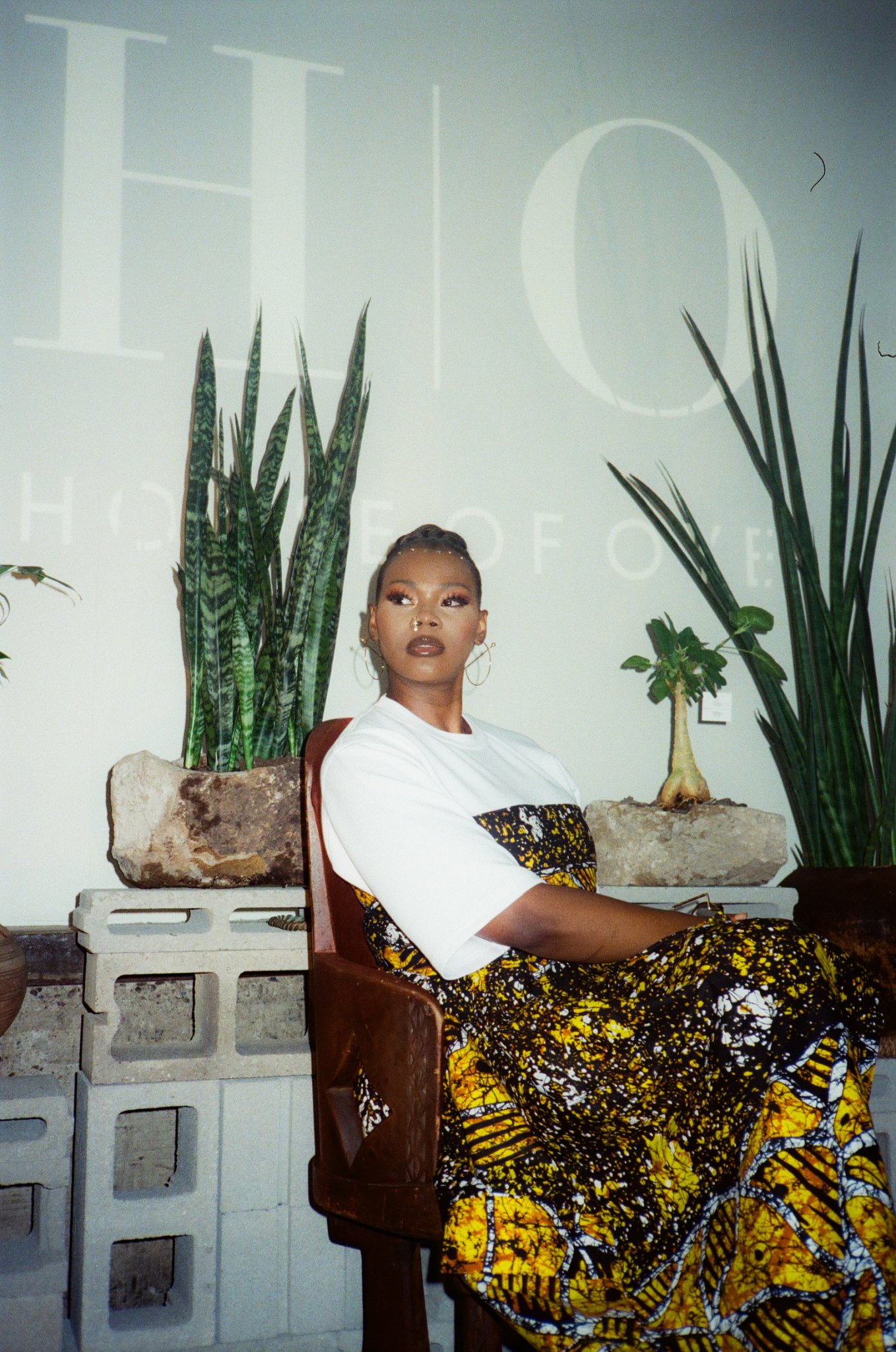
ScopeA curated market and community gathering centering five Black and Indigenous owned businesses — each invited not as vendors, but as the main event.
When House of Oye opened its doors, the vision was always larger than the studio itself. Not just a space to make work in — but a living room for the community. A place where Blackness could be centered, where design, storytelling, and imagination could exist side by side and spill out into the street.
The Bespoke Pop-Up Market was an act of reciprocity. Five Black and Indigenous owned businesses — makers working across fashion, art, botanicals, and more — had each in their own way helped shape the world House of Oye was building. This was an opportunity to turn the space back over to them. Not as supporting elements folded into the studio's narrative, but as the main event — each given room to present their practice with the same intention and care House of Oye brings to its own work.
The result felt less like a market and more like a family reunion. House of Oye exists to build more than immersive environments. It exists to build the conditions for a community to recognize its own brilliance, gather around it, and thrive.
Two Artists, One Home
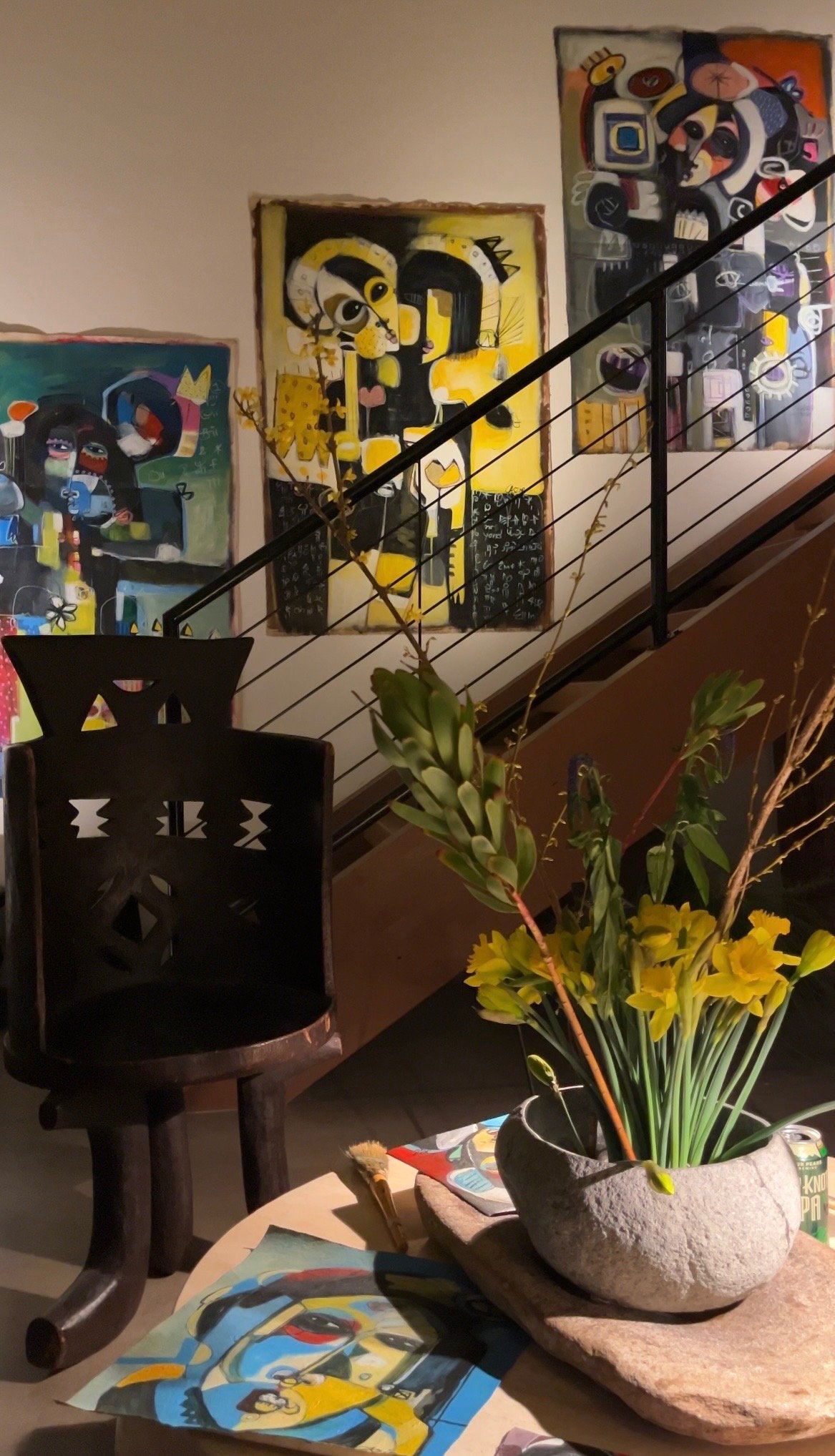
ScopeA spatial and painterly collaboration between House of Oye and CasziB — asking what happens when a home is rebuilt entirely around a painter's vision.
CasziB's canvases are not quiet. Working in Afro-abstract expressionism, his layered compositions move through migration, memory, and the tension between ancestral African identity and Western influence. To stand in front of his work is to feel the weight of a continent in motion. It does not ask to be admired. It asks to be reckoned with.
Rather than installing his paintings into an existing environment, the two artists restructured the home itself — repositioning objects, textiles, and artifacts to respond directly to the emotional and visual frequency of each canvas. Every placement was a dialogue. The space was not dressed around the work. It was rebuilt to think alongside it.
The result was an environment where two bodies of practice met as equals — one rooted in paint, gesture, and diasporic memory; the other in object, space, and ancestral presence — both asking the same question: what does it look like when African and diasporic intelligence is given an entire home to speak from?
Leyline Almanac — Book Talk
ScopeHouse of Oye was invited to design the spatial environment for the third edition release of the Leyline Almanac — a planner and cultural resource tracing 12 pre-colonial sacred sites and refusing colonial timekeeping as an act of spatial sovereignty.
The Leyline Almanac is not a planner. It is a framework for liberation. Created by Saki Savavi — liberation cartographer, independent scholar, and practitioner of Hoodoo and African traditional religion — the Almanac guides practitioners through cosmic rhythm, lunar cycles, and sacred sites research as an alternative to the inherited coordinates of colonial cartography.
It was a natural collaboration. House of Oye and the Leyline Almanac are asking the same question from different directions: what does it look like to build a world entirely outside of colonial frameworks, using the intelligence that was always already there? The evening was capped at 12 guests — a number that was not incidental. It mirrored the 12 pre-colonial sacred sites at the heart of the Almanac, turning the gathering itself into a spatial extension of the work.
Every design decision responded directly to Savavi's practice. African artifacts and textiles were selected for their ancestral resonance. Botanical elements from Rozet Nursery anchored each of the 12 sacred sites in the room. The result was a gathering that felt like a continuation of the work itself — two practices rooted in the same refusal, held together in a single room.
House of Oye does not work in isolation.
Every collaboration is an extension of the studio's core inquiry — what does it look like to build a world entirely from African and diasporic intelligence, for the people who have always lived inside it? Each partnership above represents that question meeting another practice, another vision, another body of work — and the space that became possible when they were brought into conversation.
Every space in this portfolio was asked to do one thing above all else: make the people inside it feel seen. Not observed. Not welcomed. Seen — in their lineage, their memory, their inheritance. That is what House of Oye builds toward in every room.
You have been looking for a space that understands what you are trying to say. House of Oye was built to say it with you.